INITIAL DFS ANALYSIS: In resected stage IB-IIIA, median DFS was not reached (95% CI: NE, NE) for TAGRISSO vs 27.5 months (95% CI: 22.0, 35.0) for placebo; HR=0.20 (95% CI: 0.15, 0.27); P<0.0001; N=682.1*
UPDATED DFS ANALYSIS
65.8 months (95% CI: 61.7, NC) median DFS for TAGRISSO
and 28.1 months (95% CI: 22.1, 35.0) for placebo
65.8 months (95% CI: 61.7, NC)
median DFS for TAGRISSO and 28.1 months
(95% CI: 22.1, 35.0) for placebo
in resected stage IB-IIIA3‡
Statistically significant OS
51%
reduced risk of death
vs placebo
(95% CI: 0.34, 0.70); P<0.001; N=682
2x
vs placebo in resected stage IB-IIIA
HR=0.49 (95% CI: 0.34, 0.70); P<0.001; N=6823


51% reduced risk of death vs placebo3
88% OS rate at 5 years with TAGRISSO
(95% CI: 83, 91)3
DFS rates in patients with stage IB-IIIA EGFRm NSCLC2
- 2 YEARS 90% TAGRISSO
 55% Placebo
 - 3 YEARS 85% TAGRISSO 44% Placebo
- 4 YEARS 73% TAGRISSO 38% Placebo
- Median OS was not reached in either TAGRISSO or placebo arm3
- Subsequent therapy with open-label TAGRISSO was offered to eligible patients in the placebo arm who recurred4||
- Median follow-up in the stage IB-IIIA population (censored patients) was 61.5 months for TAGRISSO and 61.5 months for placebo. All patients have completed or discontinued study treatment3
OS IN RESECTED STAGE II-IIIA EGFRm NSCLC: The OS HR was 0.49 (95% CI: 0.33, 0.73); P<0.001; n=4703‡¶
- Median OS was not reached in either TAGRISSO or placebo arm3
- Median follow-up in the stage II-IIIA population (censored patients) was 61.7 months for TAGRISSO and 60.4 months for placebo. All patients have completed or discontinued study treatment3

National Comprehensive Cancer Network® (NCCN®)
Osimertinib (TAGRISSO) is the first EGFR TKI recommended by NCCN Clinical Practice Guidelines in Oncology (NCCN Guidelines®) as an adjuvant treatment option for completely resected stage IB-IIIA, stage IIIB (T3, N2) EGFRm (exon 19 deletion, exon 21 L858R mutation) NSCLC.5#**
#The NCCN Guidelines® for NSCLC provide recommendations for certain individual biomarkers that should be tested and recommend testing techniques, but do not endorse any specific commercially available biomarker assays or commercial laboratories.5
**Osimertinib is recommended for patients with completely resected stage IB-IIIA, stage IIIB (T3, N2) EGFRm (exon 19 deletion, exon 21 L858R mutation) NSCLC who received previous adjuvant chemotherapy or are ineligible to receive platinum-based chemotherapy.5
*Secondary endpoint in the ADAURA initial analysis. Primary endpoint in the initial analysis at 2 years was DFS in stage II-IIIA patients. Median DFS was not reached for TAGRISSO (95% CI: 38.8, NE) vs 19.6 months (95% CI: 16.6, 24.5) for placebo (HR=0.17 [95% CI: 0.12, 0.23]; P<0.0001).1
†Secondary endpoint in the ADAURA trial with 2 additional years of follow-up. Primary endpoint in the updated analysis was DFS in stage II-IIIA patients; median DFS was 65.8 months for TAGRISSO (95% CI: 54.4, NC) and was 21.9 months (95% CI: 16.6, 27.5) for placebo (HR=0.23 [95% CI: 0.18, 0.30]).2
‡Secondary endpoint in ADAURA.3
§OS maturity was 18% (TAGRISSO; 12%, placebo; 24%).3
||One hundred eighty-four patients in the placebo arm received a subsequent therapy. Of these patients, 88% (n=162) received an EGFR TKI, most frequently TAGRISSO (43%; n=79).3,6
¶OS maturity was 21% (TAGRISSO; 15%, placebo; 27%).3
OS results across prespecified patient subgroups6
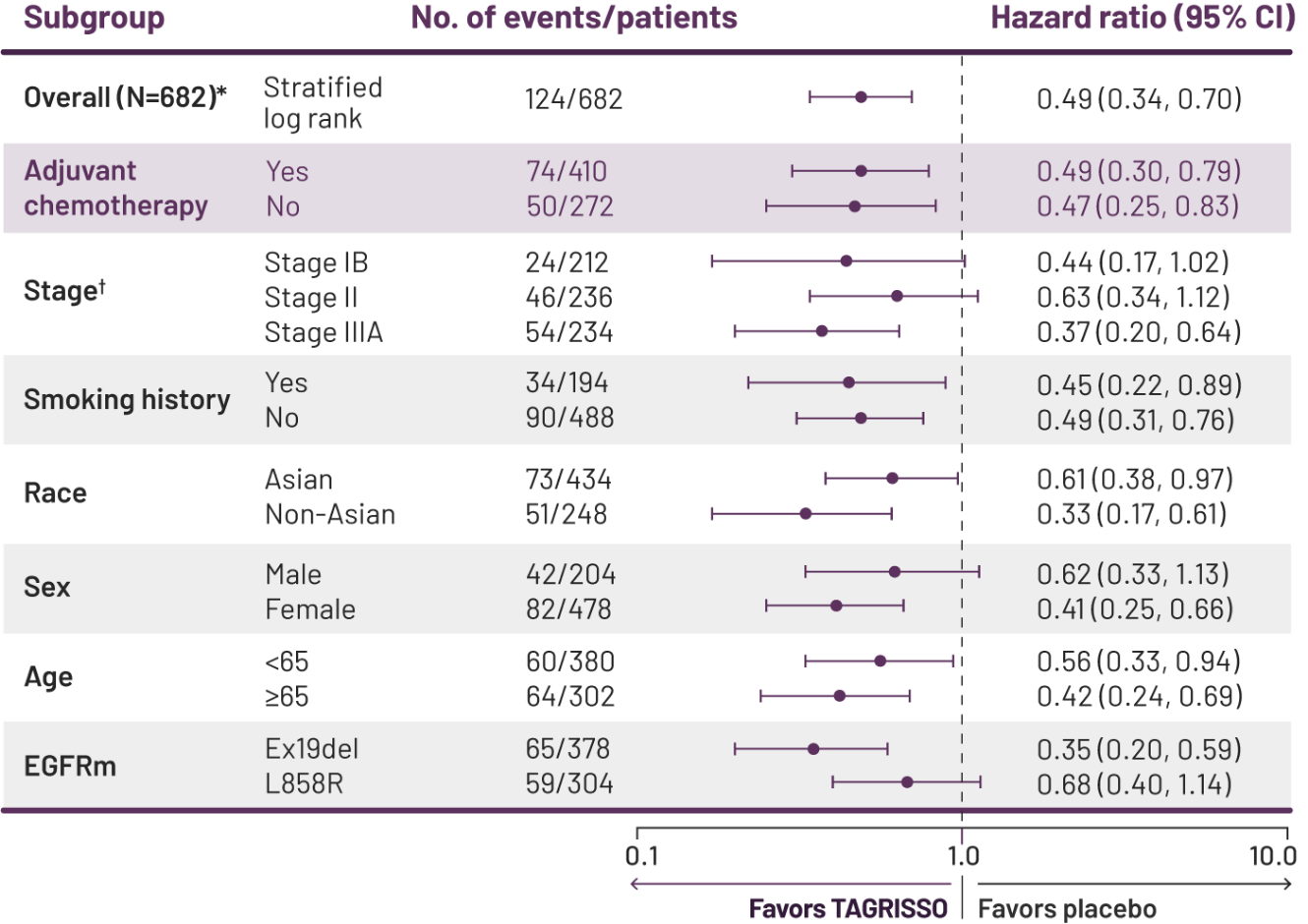
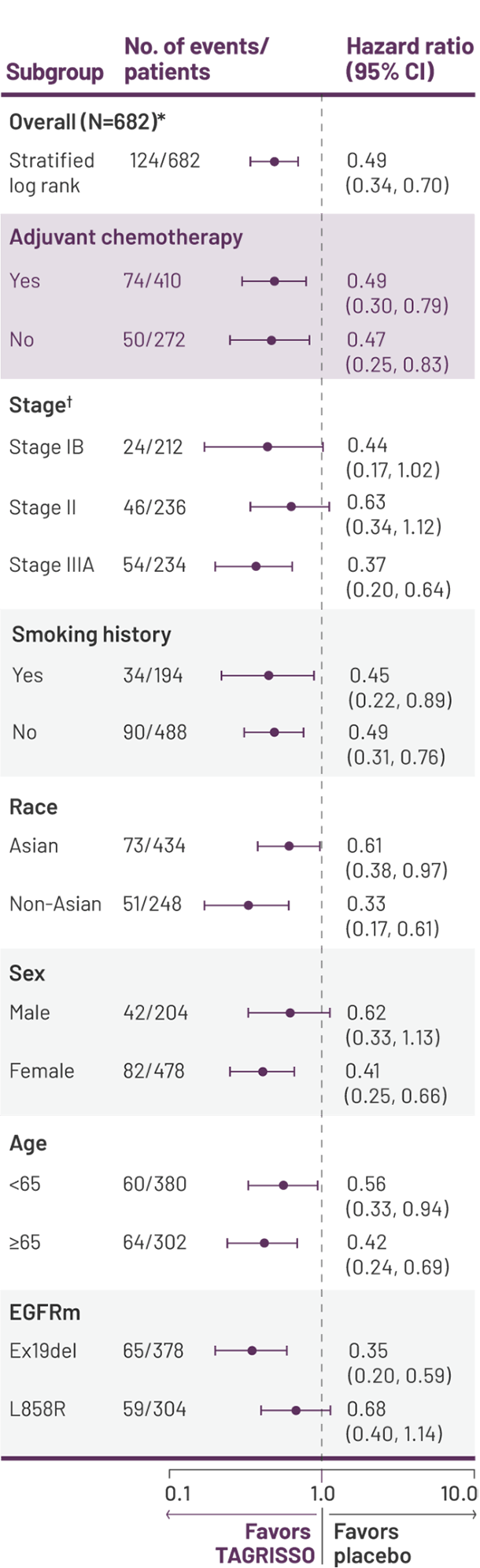
- The exploratory analysis of prespecified patient subgroups was not powered to show statistical significance
TAGRISSO is the only FDA-approved adjuvant option for resectable EGFRm NSCLC, including stage IB (T>3 cm [T2aN0])1,7-11‡
Exploratory subgroup analysis
TAGRISSO demonstrated consistent OS results with or without prior adjuvant chemotherapy6§
WITHOUT PRIOR ADJUVANT CHEMOTHERAPYII
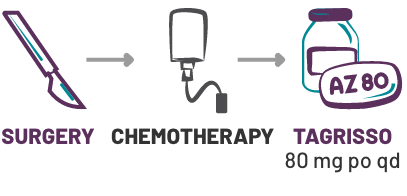
In ADAURA, patients without prior adjuvant chemotherapy were treated as follows1||:

HR0.47
(95% CI: 0.25, 0.83)6
Pill image is not actual size.
OR
WITH PRIOR ADJUVANT CHEMOTHERAPYII
In ADAURA, patients with prior adjuvant chemotherapy were treated as follows1||:
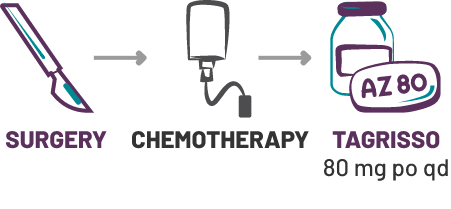
HR0.49
(95% CI: 0.30, 0.79)6
Although prior adjuvant chemotherapy use was allowed, it was not required in the ADAURA trial12
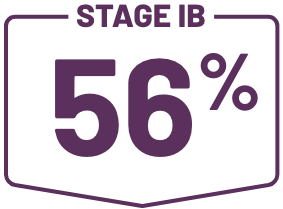
PRIOR ADJUVANT CHEMOTHERAPY USE IN ADAURA BY STAGE13
| Characteristic | TAGRISSO | Placebo |
|---|---|---|
| Stage IB | 25% (n=27) | 28% (n=30) |
| Stage II | 70% (n=80) | 73% (n=85) |
| Stage IIIA | 81% (n=95) | 78% (n=92) |
*Stage IB-IIIA population.6
†Based on AJCC 7th edition.3
‡TAGRISSO is indicated as adjuvant therapy after tumor resection in adult patients with non-small cell lung cancer (NSCLC) whose tumors have epidermal growth factor receptor (EGFR) exon 19 deletions or exon 21 L858R mutations, as detected by an FDA-approved test.1
§In ADAURA, delivery of adjuvant chemotherapy was allowed, but not mandatory, and was decided by the physician and patient prior to study enrollment. 60% of patients received prior adjuvant chemotherapy (adjuvant TAGRISSO arm: stage IB, 25%; stage II, 70%; stage IIIA, 81%; placebo arm: stage IB, 28%; stage II, 73%; stage IIIA, 78%).12,13
IIIn the ADAURA trial, patients received adjuvant TAGRISSO for up to 3 years or until disease recurrence or unacceptable toxicity.1
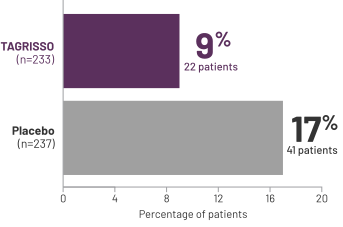
Adjuvant TAGRISSO: CNS DFS in the updated DFS analysis with additional 2 years of follow-up2




76%
reduced risk of CNS recurrence or
death with adjuvant TAGRISSO in a
post hoc
analysis of the primary
endpoint subset (stage II-IIIA) HR=0.24 (95% CI: 0.14, 0.42)
- In the updated DFS analysis of the primary endpoint subset (stage II-IIIA), the median CNS DFS was not reached (95% CI: 65.8 months, NC) in the TAGRISSO arm and was not reached (95% CI: NC, NC) in the placebo arm; HR=0.24 (95% CI: 0.14, 0.42)
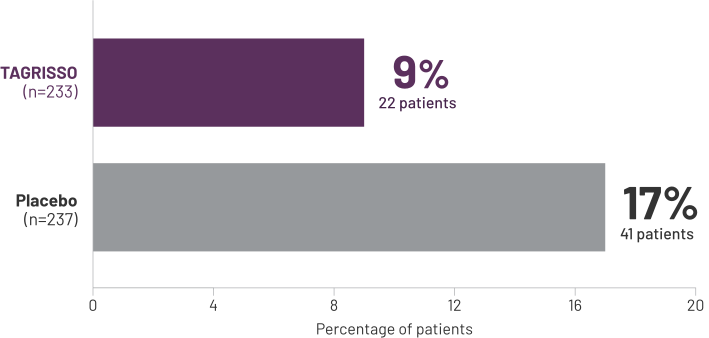
- 22 patients in the TAGRISSO arm and 41 patients in the placebo arm experienced CNS recurrence or death
- CNS DFS was a post hoc analysis based on data from the updated DFS data cutoff at 4 years; the analysis was not powered to show statistical significance
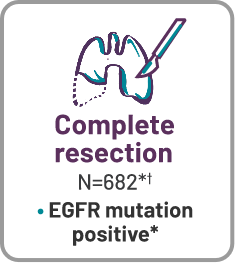
ADAURA: A phase III double-blind trial in patients with completely resected stage IB-IIIA EGFRm NSCLC1,12*†
Adjuvant chemotherapy before randomization was allowed, but not mandatory

Adjuvant chemotherapy before randomization was allowed, but not mandatory

With prior chemotherapy maximum interval from surgery to randomization was up to 26 weeks

Without prior chemotherapy maximum interval from surgery to randomization was up to 10 weeks
1:1
Randomized


TAGRISSO
80 mg po qd
(n=339)

Placebo
(Standard of care) (n=343)
Study treatment continued for 3 years or until:
- Unacceptable toxicity
- Disease recurrence
Pill images are not actual size.
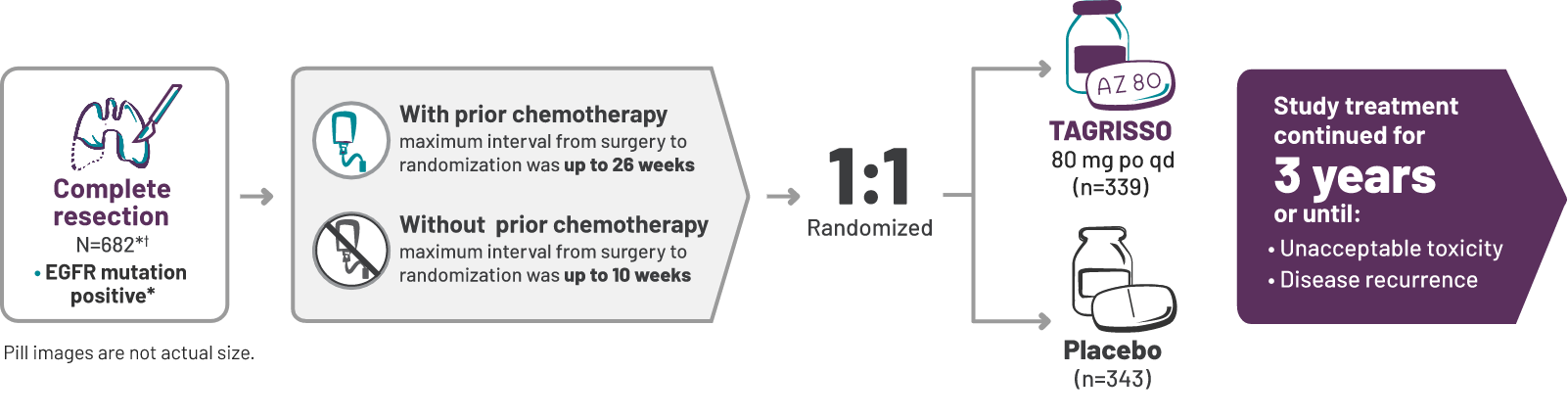
ADAURA included completely resected stage IB-IIIA patients without any exclusion criteria on tumor size—tumors >3 cm (T2aN0) were included1,7-11
Primary endpoint: DFS by investigator assessment in stage II-IIIA patients.12
Secondary endpoints: DFS in the overall population (stage IB-IIIA); DFS rate at 2, 3, 4, and 5 years; overall survival (stage II-IIIA and overall population); safety; and health-related QoL.1,4,12
Exploratory endpoints: Assessment of the site or sites of recurrence (including the CNS); time to CNS disease recurrence or death.12
Key inclusion criteria: Patients were required to have a WHO PS of 0/1 and an exon 19 deletion or exon 21 L858R mutation. Patients were required to be ≥18 years old. Brain imaging, if not completed preoperatively, was required. Complete resection with negative margins was required.12,13
Key exclusion criteria: Wedge resection or radiation therapy.13
*Patients with EGFRm NSCLC (exon 19 deletion or exon 21 L858R mutation) with completely resected stage IB, II, and IIIA tumors as defined by AJCC 7th edition were enrolled in ADAURA.1
†Patients were stratified by stage (IB or II or IIIA), EGFR mutation (exon 19 deletion or exon 21 L858R mutation), and race (Asian or non-Asian).1
ADAURA included stage IB-IIIA patients with completely resected EGFRm NSCLC and a range of clinicopathologic profiles, including smokers, non-Asians, and men1

| Characteristic | TAGRISSO (n=339) |
Placebo (n=343) |
||
|---|---|---|---|---|
| Staging at diagnosis | ||||
| IB | 32% | 32% | ||
| II | 34% | 34% | ||
| IIIA | 35% | 34% | ||
| Received prior adjuvant chemotherapy | ||||
| IB | 25% | 28% | ||
| II | 70% | 73% | ||
| IIIA | 81% | 78% | ||
| Smoking history | 32% | 25% | ||
| Non-Asian | 36% | 36% | ||
| Male | 32% | 28% | ||
| Median age, years (range) | 64 (30-86) | 62 (31-82) | ||
| WHO PS: 0/1 | 64%/36% | 64%/36% | ||
Be sure to test every eligible patient for EGFR mutations, regardless of phenotype

Not actual patients.
ADAURA included ALL patients with completely resected stage IB-III NSCLC, regardless of AJCC 7th or 8th edition
| Presentation | AJCC 7th edition | AJCC 8th edition |
|---|---|---|
| T2a >3-4 cm-sized tumors and NO nodal involvement† | Stage IB | Stage IB |
| T2b >4-5 cm-sized tumors and NO nodal involvement† | Stage IB | Stage IIA |
| >5 cm-sized tumors, or invasive or satellite primary tumors, and N2 nodal involvement‡ |
Stage IIIA | Stage IIIB |
*Although patients in ADAURA are staged according to the AJCC 7th edition, all randomized patients are also staged at baseline according to the AJCC 8th edition classification.7
†Based on the AJCC 8th edition updates, some patients who were originally classified as stage IB by AJCC 7th edition are still classified as stage IB, while some are now considered to be stage IIA. Stage IB patients with T2a >3-4 cm-sized tumors and NO nodal involvement are still considered stage IB. Stage IB patients with T2b >4-5 cm-sized tumors (formerly T2a in AJCC 7th edition) and NO nodal involvement are now considered stage IIA.10,11
‡Based on the AJCC 8th edition updates, certain patients classified as stage IIIA by AJCC 7th edition are now considered to be stage IIIB. In the AJCC 8th edition, stage IIIB may reflect N2 nodal disease, including N2 with T3 invasion or N2 with T3 satellite. Thus, these stage IIIB patients, as defined by AJCC 8th edition updates, were included in the ADAURA trial.10,11
Help prevent recurrence: Identify every eligible patient with stage IB-IIIA EGFRm-driven NSCLC who may benefit from adjuvant TAGRISSO
Osimertinib (TAGRISSO) is the first and only EGFR TKI recommended by NCCN Guidelines as an adjuvant treatment option for completely resected stage IB-IIIA, stage IIIB (T3, N2) EGFRm (exon 19 deletion, exon 21 L858R mutation) NSCLC.5*†
*The NCCN Guidelines for NSCLC provide recommendations for certain individual biomarkers that should be tested and recommend testing techniques, but do not endorse any specific commercially available biomarker assays or commercial laboratories.5
†Osimertinib is recommended for patients with completely resected stage IB-IIIA, stage IIIB (T3, N2) EGFRm (exon 19 deletion, exon 21 L858R mutation) NSCLC who received previous adjuvant chemotherapy or are ineligible to receive platinum-based chemotherapy.5

all eligible patients to determine if EGFR is the driver of disease

mutational status before making adjuvant treatment decisions

eligible patients with adjuvant TAGRISSO for up to 3 years1‡
Pill image is not actual size.
Approximately half of patients with resected stage II-III NSCLC do not receive treatment after surgery—reconsider what adjuvant therapy may mean for your patients with resectable EGFRm NSCLC14§
‡Or until disease recurrence or unacceptable toxicity.1
§A retrospective study of 35,134 patients with resected stage II or III NSCLC (AJCC 8th edition) identified from the National Cancer Database from 2006 to 2012. Patients were excluded if the use of surgery, chemotherapy, or radiotherapy was unknown, if the timing of chemotherapy was unknown, if both adjuvant and neoadjuvant chemotherapy was administered, or if radiotherapy was used. Of the total population, 18,684 (53%) received surgery alone; 1154 (3%) received surgery with neoadjuvant chemotherapy; and 15,296 (44%) received surgery with adjuvant chemotherapy.14
